What the world’s employers are really hiring for this decade — and how a student gets ready now.
Here’s a number that should reframe how every family thinks about “a safe career.” By 2030, the world’s employers expect about 170 million new jobs created and 92 million displaced — a net gain of roughly 78 million, according to the World Economic Forum’s Future of Jobs Report 2025, built from the answers of over 1,000 major companies.
That’s not a small reshuffle. It’s a churn of around a fifth of all jobs in less than five years. Some fields are climbing fast. Others are quietly disappearing. The students who win this decade aren’t the ones who picked the “right” job title at 17 — they’re the ones who built the right skills underneath it.
The careers on the way up
The WEF’s fastest-growing roles cluster in a few clear directions:
- Technology — AI and machine learning specialists, big data specialists, software developers, cybersecurity professionals. These sit right at the top.
- Finance-meets-tech — fintech engineering is among the single fastest-growing roles named.
- The green transition — renewable-energy engineers, environmental specialists, electric-vehicle roles. Climate is creating jobs, not just headlines.
- Care and health — nursing, counselling, social work, and allied health are among the largest growing categories as populations age and mental-health awareness rises.
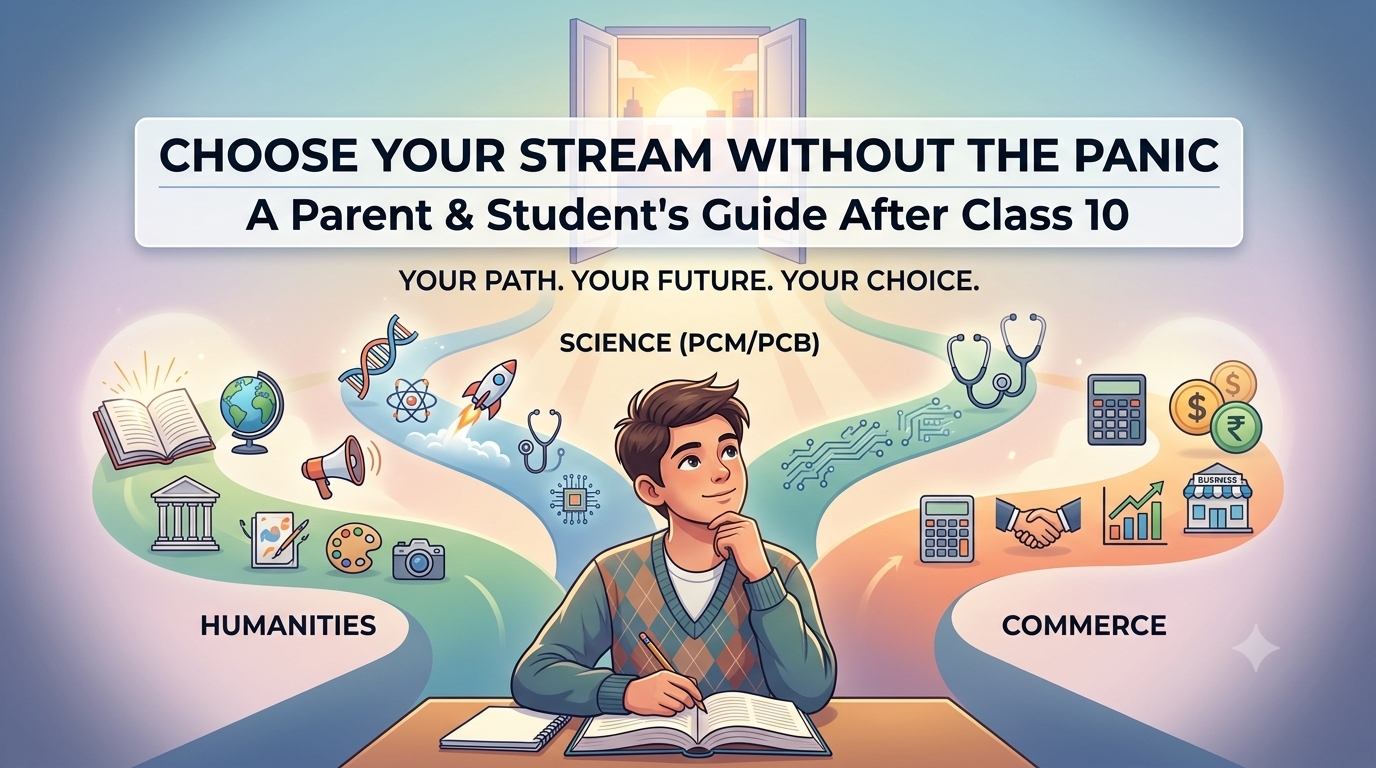
Notice the range. It’s not all coding. There’s serious room here for a Commerce student (fintech), a Humanities student (counselling, policy), and a Science student (AI, green tech) alike.
The jobs quietly shrinking
It’s only fair to say the other half out loud. The WEF expects sharp declines in routine, repeatable roles: data entry clerks, bank tellers, basic administrative and secretarial work, and similar tasks that software now does faster. None of this means those workers vanish overnight — but a student planning a future around purely routine work is planning around a shrinking floor
The dividing line is simple: work that’s predictable and repeatable is at risk. Work that needs judgement, creativity, people, or complex problem-solving is not.
The skills that travel across every field
This is the part worth memorising, because it survives whatever job titles come and go.
When the WEF asked employers which skills matter most right now, the top answer was analytical thinking — essential to seven in ten companies. The fastest-growing skills were led by AI and big data, cybersecurity, and technological literacy — but right alongside them sat distinctly human ones: creative thinking, resilience and adaptability, curiosity and lifelong learning, and leadership.
And here’s the stat that ties it together: employers expect roughly 39% of today’s core workplace skills to change by 2030. Almost two in five. Which means the most important skill of all isn’t on any single list — it’s the ability to keep learning after the formal education ends
Why "interdisciplinary" stopped being a buzzword
For years, “interdisciplinary” sounded like something on a brochure. Now it’s how the best careers actually work.
The doctor who understands data. The designer who understands psychology. The commerce graduate who can code. The policy expert who can read a spreadsheet. The most valuable people increasingly live between fields, because that’s where the hardest, least-automatable problems sit.
India’s own education system is catching up to this. The National Education Policy 2020 built four-year degrees with minors and double majors specifically so students can combine subjects instead of being locked into one. The student who uses that flexibility deliberately — pairing a strong base subject with a future-facing skill — is building exactly the profile employers describe wanting.
So what should a student actually do?
You can’t predict the perfect job a decade out. You can get ready for almost any of them.
- Pick a strong base, then layer. Whatever the stream, add one future-facing skill on top — data, AI literacy, design, or sharp communication.
- Build the human skills on purpose. Leadership, creativity, and resilience grow through clubs, projects, teams, and real responsibility — not lectures. Start early.
- Make learning a habit, not an event. With 39% of skills shifting by 2030, the students who treat learning as ongoing will keep adapting long after others stall.
- Stay curious about the edges. The most interesting careers of this decade are forming where two fields meet. Keep one foot in something outside your “main” subject.
The reassuring part
This sounds like a lot of change, and it is. But it’s also the most opportunity-rich moment in a generation to be young and curious. Around 170 million new roles are coming. They’ll go to people who stayed adaptable, kept learning, and built skills that machines can’t easily copy.
That’s not luck. It’s a choice a student can start making today.