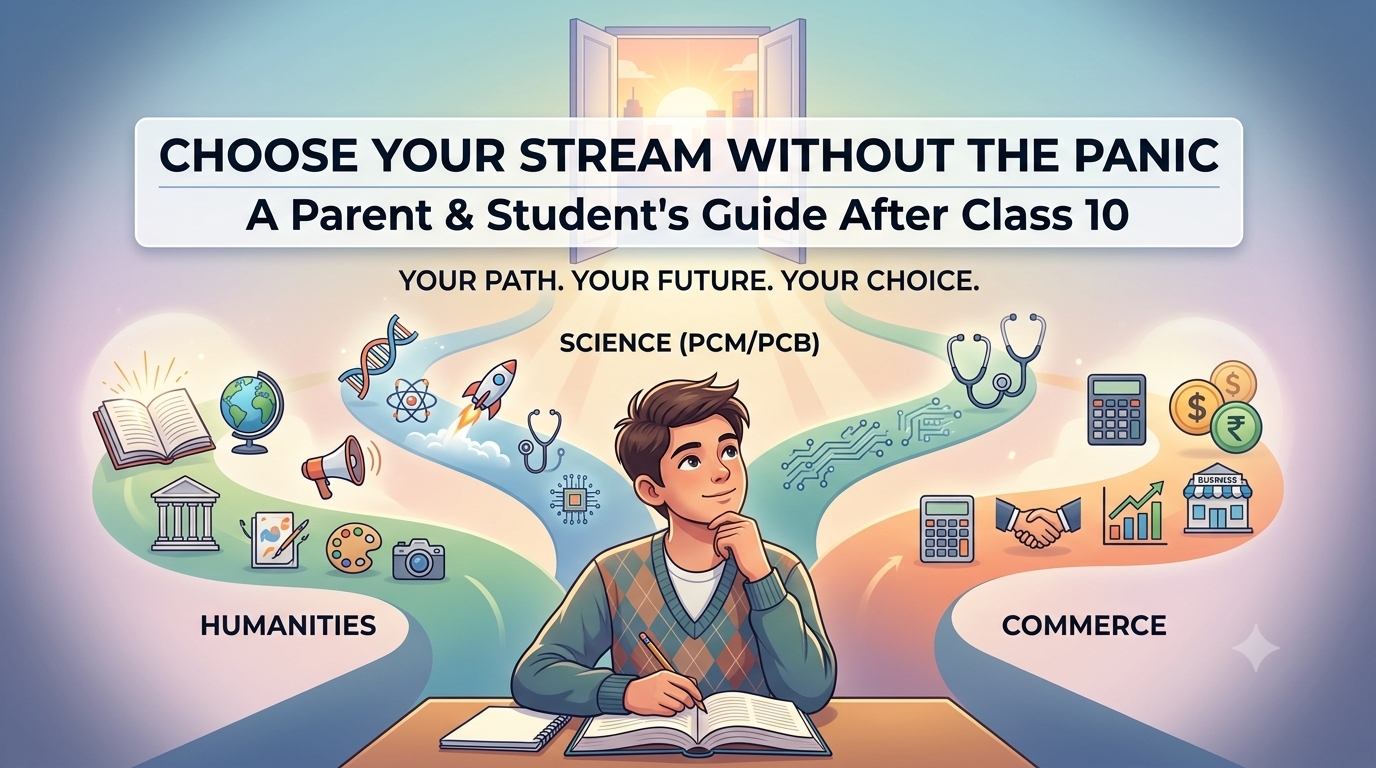
For students finishing Class 10 — and the parents losing sleep alongside them.
Let’s get one myth out of the way first. There is no “best” stream. Not Science, not Commerce, not Humanities. Anyone who tells your child otherwise is selling certainty that doesn’t exist.
What does exist is a best stream for a particular student — and finding it has almost nothing to do with which one sounds most impressive at a family gathering. So before the WhatsApp forwards and well-meaning uncles take over, let’s slow down and think this through properly.
Your worry is not wrong. It's just incomplete.
I never tell parents their fear is silly. It isn’t. You grew up in a world where “doctor, engineer, or struggle” felt close to the truth, and you’ve spent two decades making sacrifices so your child wouldn’t have to struggle the way you might have. Of course you want the safe road. That’s love, even when it comes out sounding like a fight.
Here’s where I gently push, though. The map you’re using is real, but it’s old.
The jobs that are actually growing fastest now spread across far more than two professions — data and AI roles, yes, but also design, finance and fintech, psychology and counselling, public policy, the whole green-energy field. When the World Economic Forum asked a thousand-odd big employers what they’re hiring for this decade, the most wanted skill wasn’t a degree at all. It was the ability to think clearly and solve problems. Your child can build that in medicine. They can also build it in the thing they actually love — and they’ll build it faster there, because nobody does their best work in a subject they resent.
I’ve watched the resentment version play out. The student who took Science to keep the peace, sat through two miserable years, scraped through entrance exams, started a degree they hated, and came back to me at nineteen asking how to start over. We could have saved them those years if someone had been willing to take their interest seriously at fifteen.
What the fight is usually really about
Most of these arguments aren’t actually about Science versus Arts. They’re about trust.
The parent is saying, underneath the words, I’m scared you’ll choose something that leaves you unsafe, and I won’t be able to protect you. The child is saying, I’m scared you’ll never see me as capable if I don’t do what you pictured. Both are frightened. Both are talking past each other. And the subject becomes the battlefield because the real thing is too tender to say directly.
So when families sit with me, I don’t start with careers. I start by getting each side to say the scared part plainly. It changes the temperature in the room almost every time.
A way through that isn't surrender
ou don’t have to choose between bulldozing your child and abandoning your judgement. There’s a middle road, and it’s the one I usually walk families down.
Get curious before you get firm. Ask your child to show you, properly, what this field is and where it leads — not a vague “I like art,” but the actual courses, the actual careers, the actual people doing it well. Make them do the homework. If the interest is real, they’ll rise to it, and you’ll learn things about the field that ease your worry. If it’s a passing fancy, that usually surfaces too.
And let a neutral person into the conversation. Not to take sides — to take the heat out. A good psychometric assessment plus an honest sit-down often does something neither parent nor child can do alone: it separates the child’s genuine aptitudes from both your anxiety and their fifteen-year-old impulsiveness. Sometimes it confirms the child’s instinct. Sometimes it surprises everyone. Either way, the decision stops being a tug-of-war and starts being a shared read of the same evidence.
The line I leave parents with
You will not lose your child by listening to them. You’re far more likely to lose them by winning the argument.
The students who do best are almost never the ones who were forced onto the “right” road. They’re the ones whose parents stayed worried — that’s allowed — but stayed open. Who said, in effect, show me this is real, and I’ll back you. That sentence has rescued more careers in my office than any cut-off list ever did.
If your home is stuck in the two-chairs standoff, come in before the decision hardens. We do this gently, and we do it often. There’s usually a road that lets your child chase what lights them up and lets you sleep at night. Finding it is most of what we do.