For students finishing Class 10 — and the parents losing sleep alongside them.
Let’s get one myth out of the way first. There is no “best” stream. Not Science, not Commerce, not Humanities. Anyone who tells your child otherwise is selling certainty that doesn’t exist.
What does exist is a best stream for a particular student — and finding it has almost nothing to do with which one sounds most impressive at a family gathering. So before the WhatsApp forwards and well-meaning uncles take over, let’s slow down and think this through properly.
Why this decision feels so heavy (and why it's lighter than you think)
For most families, Class 10 feels like the moment a child’s entire future gets locked in. Pick Science and you’re “set.” Pick anything else and people quietly worry.
Here’s the reassuring truth: that wall between streams isn’t what it used to be. Under the National Education Policy 2020, India’s new four-year undergraduate degrees come with minors, double majors, and the ability to combine subjects across fields. A student can study Economics with a minor in Data Science. A Science student can pivot toward design. The rigid “Science can do everything, Arts can do nothing” hierarchy is breaking down — slowly in conversation, faster in reality.
So the Class 10 choice matters. But it’s a fork in the road, not a life sentence.
The three streams, honestly
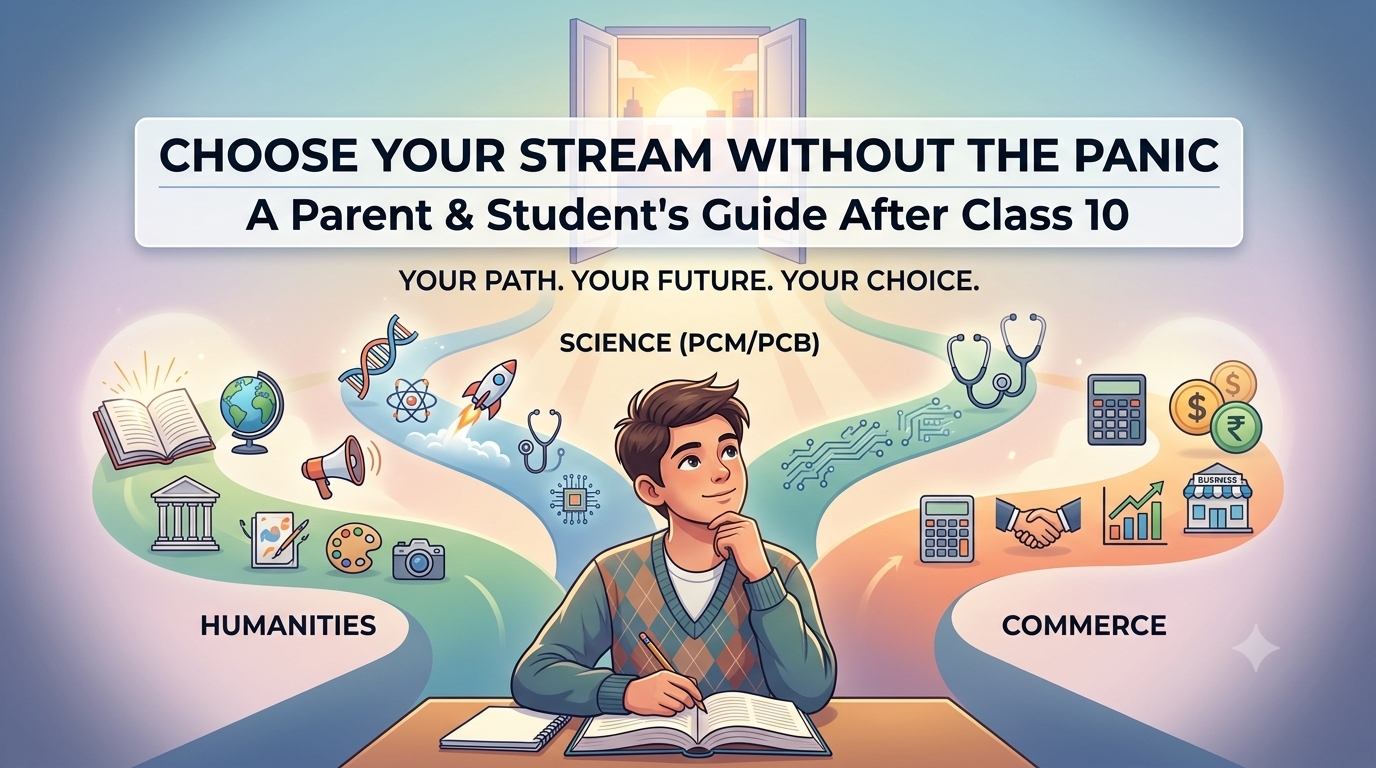
Science (PCM / PCB). Strong for students who genuinely enjoy problem-solving, maths, or biology — and who can sit with hard concepts without giving up. It keeps engineering, medicine, research, architecture, and data-heavy fields open. The mistake families make is choosing Science as insurance for a child who quietly dreads it. That insurance has a cost: two miserable years and weaker marks.
Commerce. Underrated and unfairly treated as a “backup.” It’s the natural home for future work in finance, business, economics, chartered accountancy, law, and entrepreneurship. For a student who’s curious about how money, markets, and organisations actually work, Commerce is a strong first choice, not a consolation prize.
Humanities / Arts. The most misunderstood stream in India, and often the most powerful. It opens law, psychology, design, journalism, civil services, public policy, economics, and the fast-growing creative and social-impact sectors. Picking Humanities because a child loves history, language, or human behaviour is a sign of clarity, not failure.
The question to ask instead of "which stream?"
Don’t start with the subject. Start with how your child likes to think.
Do they light up solving a tricky maths problem, or telling a story? Do they enjoy taking things apart, or understanding people? Are they drawn to numbers, systems, words, or images? The stream should follow the thinking style — not the other way around.
And here’s the data point worth holding onto: when the World Economic Forum surveyed over 1,000 global employers for its Future of Jobs Report 2025, the single most in-demand skill wasn’t tied to any one stream. It was analytical thinking, named essential by seven in ten companies. You can build that in Science, Commerce, or Humanities. What you can’t build is genuine ability in a subject your child resents.
CUET changes the maths too
One more shift parents should know about. Admission to Delhi University and a large number of central and private universities now runs through CUET — the Common University Entrance Test — instead of a dozen separate exams or pure board cut-offs.
What that means in practice: the stream you choose in Class 11 shapes which CUET subjects you can sit, which shapes which courses open up. It’s worth thinking two steps ahead — not panicking, just planning.
How to actually decide
Try this over a calm weekend, not the night before forms are due:
- Separate the child’s voice from the noise. Ask what they are drawn to, before anyone else weighs in.
- Look at strengths honestly. Marks matter, but so does which subjects they’d happily study for, unprompted.
- Map it loosely forward. Not “what’s the salary” — but “what kind of work would this person enjoy doing all day?”
- Get a structured read. A good psychometric assessment plus a real conversation with a counsellor cuts through a lot of guesswork. It won’t decide for you, but it gives you a clearer mirror.
A word to parents
Your instinct to protect your child’s future is right. The trap is protecting it by choosing safety over fit. A student who’s a little behind in a subject they love will almost always outrun a student who’s miserable in a subject they were pushed into.
Choose the stream that fits the person. The career will follow — and these days, it has far more doors than it used to.